
Meta Description:
Sukanya Samriddhi Yojana 2026 complete guide covering eligibility, interest rate, minimum deposit, maximum deposit, maturity, withdrawal rules, tax benefits and SSY calculator.
Focus Keyword:
Sukanya Samriddhi Yojana 2026
SEO Keywords:
Sukanya Samriddhi Yojana 2026, SSY 2026, Sukanya Samriddhi Yojana interest rate, SSY interest rate, Sukanya Samriddhi Yojana calculator, SSY maturity calculator, Sukanya Yojana, SSY eligibility, SSY minimum deposit, SSY maximum deposit, Sukanya Samriddhi Account, SSY withdrawal rules, SSY tax benefits
Sukanya Samriddhi Yojana 2026: Complete Guide to Eligibility, Interest Rate, Deposit, Tax Benefits & Maturity
Sukanya Samriddhi Yojana (SSY) is a government-backed small savings scheme designed to help parents and guardians build a secure financial fund for the education and future of a girl child. The scheme encourages long-term savings by offering an attractive interest rate, tax benefits and government-backed security.
In this detailed guide, you will learn about Sukanya Samriddhi Yojana 2026 eligibility, minimum and maximum deposit, interest rate, maturity period, withdrawal rules, tax benefits and important rules.
What is Sukanya Samriddhi Yojana?
NPS New Rules 2026: New Exit, Withdrawal & Partial Withdrawal Rules
Sukanya Samriddhi Yojana is a savings scheme introduced under the Government of India’s Beti Bachao, Beti Padhao initiative. It is specifically designed for the financial future of a girl child.
Parents or legal guardians can open an SSY account in the name of an eligible girl child and make deposits for a specified period. The accumulated amount, along with interest, can help meet major future expenses such as higher education and marriage.
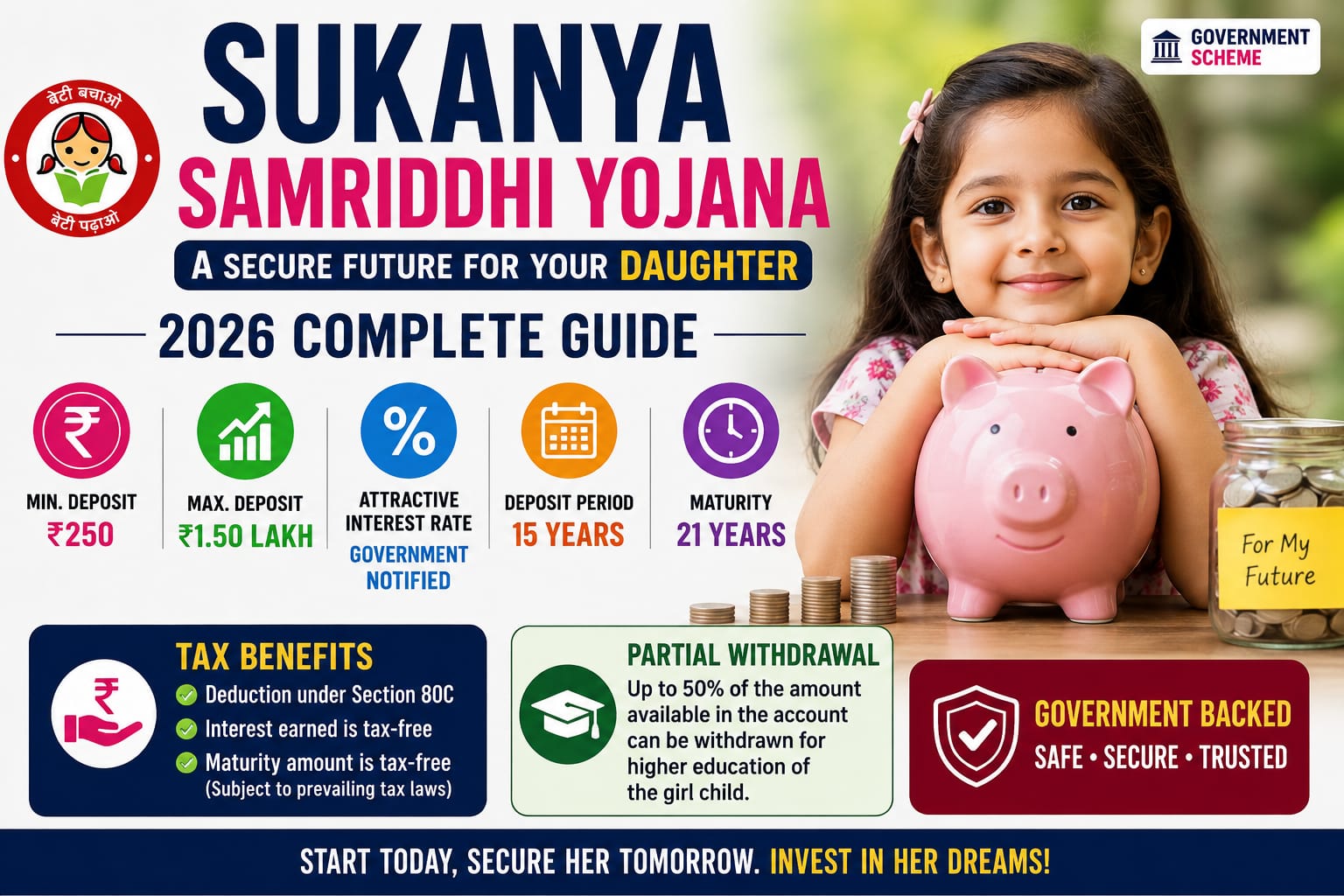
Sukanya Samriddhi Yojana 2026 – Key Highlights
| Feature | Details |
| Scheme Name | Sukanya Samriddhi Account |
| Target Beneficiary | Girl Child |
| Account Opening Age | Below 10 years |
| Minimum Deposit| | ₹250 per financial year |
| Maximum Deposit | ₹1.50 lakh per financial year |
| Deposit Period | 15 years from account opening |
| Maturity | 21 years from account opening |
| Interest | Government-notified rate |
| Tax Benefit | Eligible under applicable tax provisions |
| Account Type | Small Savings Scheme |
સપ્ટેમ્બરની આ 6 તારીખ નોટ કરે કર્મચારી-પેન્શનર્સ, પગાર-પેન્શન પર મળશે ગુડ ન્યૂઝ
Who Can Open an SSY Account?
The account can generally be opened by a parent or legal guardian on behalf of a girl child who has not completed 10 years of age at the time of account opening.
Normally, only one account can be opened in the name of a girl child. The scheme also provides specific provisions for families having more than one girl child in certain circumstances.
Sukanya Samriddhi Yojana Minimum and Maximum Deposit
A minimum contribution of ₹250 per financial year is required to keep the account active.
The maximum amount that can be deposited in an SSY account in a financial year is ₹1.50 lakh.
Deposits can be made according to the applicable rules through permitted modes such as cash, cheque, demand draft or electronic means at authorised institutions.
કેન્દ્રીય કર્મચારીઓનું બોનસ ₹7,000 થી વધીને ₹21,000 થશે? જાણો લેટેસ્ટ અપડેટ
SSY Interest Rate
The interest rate on Sukanya Samriddhi Account is not permanently fixed. It is notified by the Government from time to time and may change periodically.
Therefore, before making a financial decision, account holders should verify the latest officially notified SSY interest rate.
Interest is compounded annually as per the scheme rules.
How Long Do You Need to Deposit Money?
One important feature of SSY is that deposits are required for 15 years from the date of opening the account.
However, the account generally continues until 21 years from the date of opening, subject to the scheme’s rules.
This means parents can contribute for the initial 15-year period while the account continues to earn interest according to the applicable rules.
Sukanya Samriddhi Yojana Maturity
The SSY account normally matures after 21 years from the date of opening.
At maturity, the account holder can receive the amount accumulated in the account, subject to the applicable rules.
The long maturity period makes SSY suitable for parents who want to create a long-term financial corpus for their daughter’s future.
Partial Withdrawal for Higher Education
SSY allows withdrawal of up to 50% of the amount available in the account for the purpose of higher education of the girl child, subject to the prescribed conditions.
The withdrawal is permitted after the girl child reaches the eligible age or after she has passed the required educational stage, as specified under the scheme rules.
Relevant documents may be required to establish the requirement for higher education.
Premature Closure of SSY Account
Premature closure is generally restricted and is permitted only under specified circumstances.
The scheme includes provisions relating to circumstances such as the marriage of the account holder after reaching the prescribed age and certain exceptional situations.
Account holders should check the latest official rules before requesting premature closure.
Tax Benefits Under Sukanya Samriddhi Yojana
Sukanya Samriddhi Yojana is widely known for its tax advantages.
Subject to the Income Tax Act and applicable conditions:
- Eligible contributions can qualify for deduction under Section 80C.
- Interest earned under the scheme is generally treated as tax-exempt under the applicable provisions.
- The amount received at maturity is also generally exempt, subject to prevailing tax rules.
Tax laws can change, so taxpayers should verify the current provisions for the relevant financial year.
SSY Example: ₹1,500 Monthly Saving
Suppose a parent deposits ₹1,500 every month.
Annual contribution:
₹1,500 × 12 = ₹18,000
If the parent continues contributing regularly for the permitted contribution period, a substantial long-term corpus can be created because the deposits earn compound interest.
The final maturity amount depends on the applicable government-notified interest rates and the timing of deposits.
Therefore, an exact maturity calculation should always be made using the current SSY interest rate and official scheme rules.
Documents Required for Sukanya Samriddhi Account
Generally, the following documents may be required:
- Girl child’s birth certificate
- Parent/guardian identity proof
- Parent/guardian address proof
- Passport-size photographs
- Account opening form
- Other documents required by the authorised bank or post office
The exact documentation requirements may vary according to the institution.
Where Can You Open an SSY Account?
An SSY account can be opened through eligible banks and post offices authorised to offer the scheme.
Parents should visit the concerned bank branch or post office and complete the account-opening process using the prescribed form and documents.
8th Pay Commission / કર્મચારી યુનિયનોએ 3%ના બદલે 5%થી 7% વાર્ષિક ઇન્ક્રિમેન્ટની માગ કરી, જાણો કયો ફોર્મ્યુલા કર્મચારીઓ માટે વધુ ફાયદાકારક
Important SSY Rules
Before opening or contributing to an SSY account, remember these important points:
- The girl child must satisfy the prescribed age condition at the time of account opening.
- The minimum annual deposit requirement must be maintained.
- Total deposits cannot exceed ₹1.50 lakh in a financial year.
- Deposits are required for 15 years from account opening.
- The account normally matures after 21 years.
- Partial withdrawal is subject to prescribed conditions.
- Interest rates can change according to government notifications.
- Keep the account and KYC details updated.
Benefits of Sukanya Samriddhi Yojana
- Government-Backed Savings
SSY is a government-backed small savings scheme, making it an attractive option for conservative long-term savers.
- Long-Term Wealth Creation
The combination of regular contributions and compound interest can help create a sizeable corpus over the long term.
- Tax Advantages
The scheme provides significant tax benefits under applicable tax provisions.
- Focus on Girl Child
The scheme is specifically designed to support the financial needs and future goals of a girl child.
- Flexible Contribution
Parents can contribute different amounts during the deposit period, subject to the minimum and maximum limits.
Sukanya Samriddhi Yojana vs Other Savings Options
SSY is particularly suitable for parents looking for a long-term, government-backed savings option for a girl child.
However, it should be compared with other financial products based on factors such as:
- Investment horizon
- Liquidity requirements
- Risk tolerance
- Tax treatment
- Expected returns
- Financial goals
No single financial product is suitable for everyone.
Frequently Asked Questions? – SSY 2026
Is Sukanya Samriddhi Yojana a government scheme?
Yes. Sukanya Samriddhi Account is a government-backed small savings scheme for the benefit of a girl child.
What is the maximum annual deposit in SSY?
The maximum permissible deposit is ₹1.50 lakh in a financial year.
What is the minimum annual deposit?
The minimum annual deposit is ₹250.
How many years do I have to deposit money?
Deposits are generally required for 15 years from the date of account opening.
When does the SSY account mature?
The account normally matures 21 years from the date of opening.
Can money be withdrawn before maturity?
Yes, but withdrawals are permitted only under specified conditions, including eligible higher-education requirements.
Can an SSY account be transferred?
An SSY account can be transferred between eligible post offices and authorised banks according to the applicable rules.
Final Words
Sukanya Samriddhi Yojana 2026 can be a useful long-term savings option for parents who want to build a financial corpus for their daughter’s future. Its government-backed structure, long investment horizon, compound interest and tax benefits make it an important scheme to consider for eligible families.
Before investing, always check the latest interest rate, government notifications and applicable tax rules, because scheme conditions and rates may change over time.🔎 SEO Pack

| M | T | W | T | F | S | S |
|---|---|---|---|---|---|---|
| 1 | 2 | 3 | 4 | |||
| 5 | 6 | 7 | 8 | 9 | 10 | 11 |
| 12 | 13 | 14 | 15 | 16 | 17 | 18 |
| 19 | 20 | 21 | 22 | 23 | 24 | 25 |
| 26 | 27 | 28 | 29 | 30 | 31 | |